Books on modern art often have a number of things in common. They have primarily been concerned with European and American art. They also have a tendency to be historically structured around named art movements and the personal histories of recognised artists. If we reject the notion of discrete, hermetic, self-contained, clearly identifiable movements, and get beyond the individuality of
A Language of Contemporary Art
(As reflected in relevant articles, books, texts and exhibitions) This exploration into the language of contemporary art has a number of origins and was done for several reasons. Its origins stemmed from my decision, several years ago, to delve into contemporary art: in terms of trying to understand it better; in terms of trying to get a sense of how
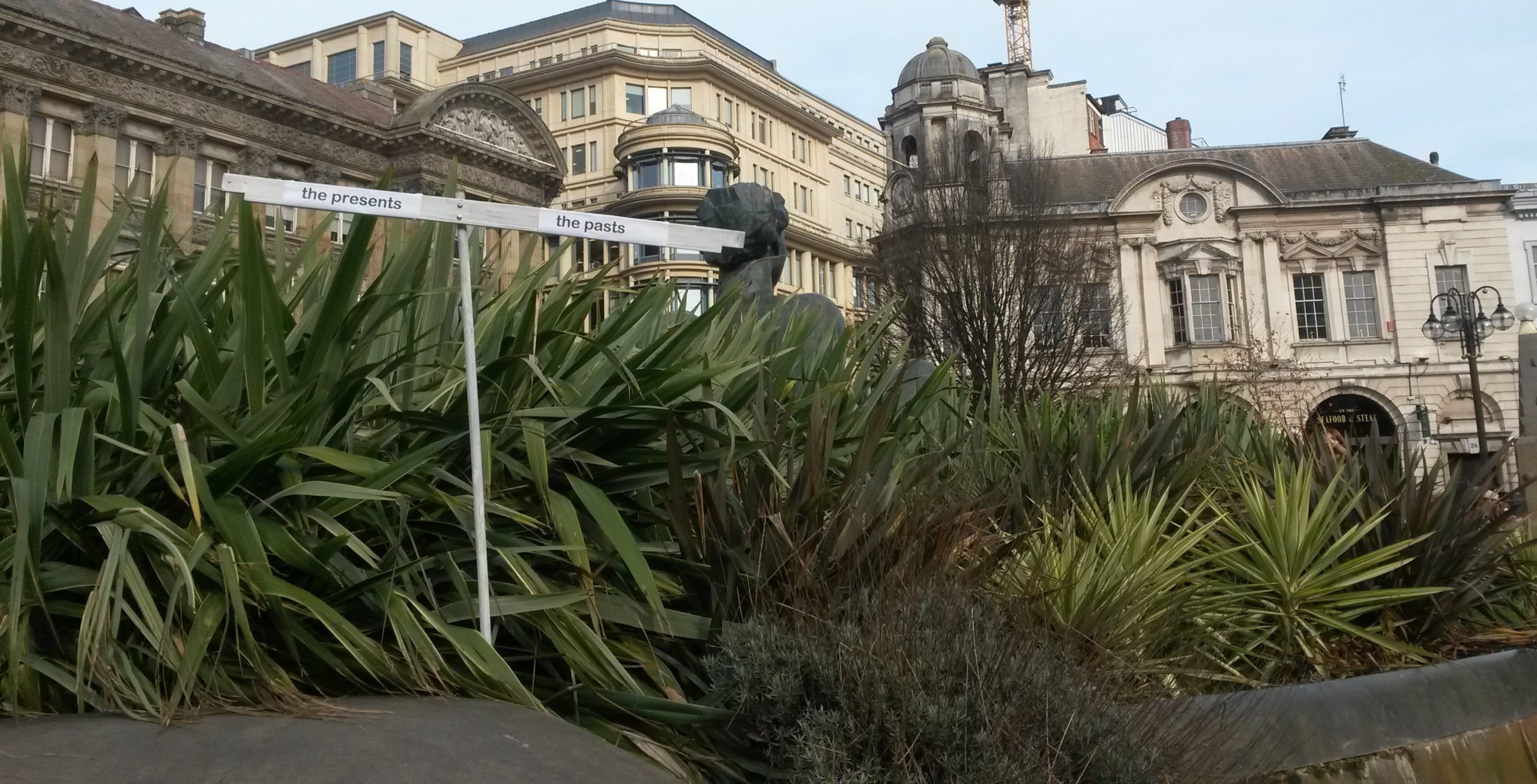
the pasts and the presents: a small-scale public art activity
The challenge was to create a simple object to be placed in a public setting in a way that could interact with an existing sense of place, and potentially prompt new perspectives for users of that space. The place chosen was a major public square in central Birmingham (UK). This acts as a place for occasional protests and demonstrations, as
Aspects of the contemporary – a context for thinking about art
In another piece of writing, it was suggested that elements of thinking about art would need to be viewed within some understandings of the contemporary context. What is it about society today that shapes how art is produced, exchanged and consumed? What is unique today about the conditions within which artists work and audiences approach the art made? What follows
Reimagining ideas from modern art as one way into thinking around contemporary artmaking
Books on modern art often have a number of things in common. They have primarily been concerned with European and American art. They also have a tendency to be historically structured around named art movements and the personal histories of recognised artists.
If we reject the notion of discrete, hermetic, self-contained, clearly identifiable movements, and get beyond the individuality of the genius-artist, we are able to condense the history of modern art into gatherings of ideas that were constructed within changing social contexts.
This then opens up the possibility of reflecting on the extent to which those outline ideas can feed through into thinking about contemporary art.
Read moreA Language of Contemporary Art
(As reflected in relevant articles, books, texts and exhibitions)
This exploration into the language of contemporary art has a number of origins and was done for several reasons.
Its origins stemmed from my decision, several years ago, to delve into contemporary art: in terms of trying to understand it better; in terms of trying to get a sense of how it was being talked about in articles, books, exhibition texts etc; and in terms of wanting to test out my own capabilities in ‘doing art’ and ‘making art’.
The starting framework for this was also a deep interest in modes of learning, and how a particular outcome might be got to by various routes – including putting together my own art curriculum (culled from the Foundation, Degree and Masters curricula of a range of universities in this country and elsewhere – selecting the elements and approaches that I felt most interested in personally pursuing in my own ways and against my own timescales). This is described elsewhere. One unit of my constructed self-learning programme was a better understanding of the language of art, in general, and contemporary art in particular.
A further driver was an interest in language and its uses. My own inclination was less in terms of looking to establish precise dictionary-type definitions, and more in terms of the flexible (and often contradictory) ways that words were used in practice. This looked for an opening up, rather than a defining down, of understandings. A specific example of this was my doctorate in sociology, which looked at the ways the concept of Community was constructed by various groups (residents, community workers, local politicians, national policy makers, academics, writers) and how various elements of meaning were differentially strung together as chains of understanding by these different groups – and how these understandings could form broad constellations of sense-making at different times or in different contexts.
In practical terms, I had to hand 50 pieces of written material from art exhibitions across the past 25 years; more than 100 newspaper and magazine articles from across the period from 1990 to the present; more than 100 books on art since 1945; a watch-later library of more than 40 YouTube videos on aspects of contemporary art – ie a rich and varied source of ways that people wrote and spoke about late-modern/contemporary art.
The job was to make some sense of all of this, for my own better understanding.
This was primarily done to fulfil part of the learning commitment I had made to myself, and also for the sheer enjoyment of attempting to think through some new topic.
A second reason emerged the more I thought about things. This was to see if the various statements gleaned from the numerous wide-ranging texts could suggest any recurring categorisations that could be used as headings to make some initial sense of things, The headings I used thus arose out of the thinking being done. These broad working categorisations, which were by no means mutually exclusive, were:
Artistic Approaches
Contents and Intentions
Artistic Mechanisms
Curating and Exhibitions
Identities and Portraitures
Narratives and Meanings
Ambiguities and Realities
Cities and Places
Memories and Histories
Fragments, Layers and Multiplicities
Each section contains numerous phrases that were things in the articles/books that struck me as interesting. These are fragments and part-phrases rather than full sentences. These listed phrases-of-interest are not in any specific order. A number of the phrases could equally be relevant to other headings. Sometimes phrases clumped together, more often they did not. They are certainly not intended to form a linear narrative, but simply to sit as fragments, any of which might trigger some response in the reader. There are many fragments, so many possibilities for thoughts being triggered – so any reader might begin to construct their own chains of ideas, building into a potential narrative that begins to make some sense to that person.
The fragments and the headings then became some kind of Thinking Framework – something that would spur further intellectual exploration – or that might trigger ideas to inform my own making of art.
This is my interpretation of the information from my particular set of sources. Others may construct things differently, from other sources. Another approach might throw up different headings, different ways of selecting and arranging phrases, different chains of meaning and different constellations of understanding. This is my constructed thinking tool It is up to me to make of it what I can. As I scan through it from time to time, certain things catch my eye and set trains of thought going. Similarly, it is up to other people to engage or not; and to make their own connections, linkages and uses.
What follows is my first attempt at putting the Thinking Framework together. It can be considered as an act of creativity at a number of different levels. It is a work in progress. As I read more, more ideas will seem worth including, but I don’t aim for it to go on forever. I am more interested in getting to a sufficiency level, where it can be something adaptable, yet fit-for-purpose, for me to use in various ways in order to progress my own learning about contemporary art and, potentially, my own practical art working.
Readers should feel free to use this Thinking Framework in whatever way they may find helpful. Its source should be quoted whenever it is shared with others.
(Note: The source of each phrase is not listed. This is a personal exploration not an academic article requiring specific references. Nor is it an attempt at originality, attempting to pass other’s words off as my own. The whole basis is that these are fragments of words as used by many others – few of which are specific insights unique to that writer. In a small number of cases, the artist source in included in brackets, simply for interest).
Read morethe pasts and the presents: a small-scale public art activity
The challenge was to create a simple object to be placed in a public setting in a way that could interact with an existing sense of place, and potentially prompt new perspectives for users of that space.
The place chosen was a major public square in central Birmingham (UK). This acts as a place for occasional protests and demonstrations, as well as being used for events and festivals. Generally, though, is simply a place to move through on the way to somewhere else. Conceptually, it is an enclosure and a container of things whilst, at the same time, being a void, a gap between buildings, an emptiness needing bodies to bring it to life.
More importantly, it is a point at which three overlapping versions of the city meet each other as three sweeping clover-leaf segments.
One broad view takes in the School of Art, the city’s Education Department; some art galleries and the city museum; a major convention centre; the theatre; the library; the Council House and other impressive buildings from the Civic Pride era of the city’s history. This is the city as art and learning.
Turn through an arc and the view is of shopping centres; major streets of city-centre stores; the city’s developing metro tramway line; and some railway stations. This is the city as retail and transport.
Turn again and the third view from the square is the district of banks, insurance offices and corporate headquarters; and the historical Jewellery Quarter. It is the city as finance and trade.
Each aspect has its own set of histories, its own ever-changing present and its own possibilities for the future. There is a point in the Square where these three segments come together. Pasts, presents and futures collide at that point.
So, it is a layered, contemporary place which can be understood in various ways. People often have little sense of the square’s intricate history and give even less thought to its potential futures. For many, it is a place that simply exists; that is simply there – where a version of the present is constantly being constructed and reconstructed.
It is a square that houses a number of different works of public art. These are monuments or large-scale pieces by commissioned artists. Putting a work of art of my own alongside these would change the location very slightly, might influence how people use the space, and could be a prompt for conversation or reflection.
Finally, the Square was often a place at which people take bearings, consult maps, admit to being a bit lost, and ask for directions. It was decided to build on this and to install a signpost at some significant spots in the Square. Rather than direct people to physical locations, this signpost would have arms pointed to ‘the pasts’ and ‘the presents’.
Aspects of the contemporary – a context for thinking about art
In another piece of writing, it was suggested that elements of thinking about art would need to be viewed within some understandings of the contemporary context. What is it about society today that shapes how art is produced, exchanged and consumed? What is unique today about the conditions within which artists work and audiences approach the art made?
What follows are some facets of the contemporary that have been proposed as defining our age (eg the period from the past few decades up to the present). Some of these might also have been put forward as descriptors of earlier periods (eg 1900-1940, or 1960-1980), but what is different now is the scale and pace associated with those elements. Other things are clearly new to the contemporary, with its electronically-driven processes.
These observations have been grouped into three broad groupings that have a high degree of interaction across each other.
Read moreArt Theorising: a process of open exploration
Art theory, like art history, is often presented in terms of sequences, schools of thought, or key individual thinkers– looking both for unique perspectives and for linkages between these.
Art theory has also tended to be Art Theory ie a bundle of expert knowledge, to be taught and written about; usually treated as a summary. It is less seen as art theorising ie a process, open to many, with ‘maybe’ and ‘good enough for now’ tentative aspects to it. From this second perspective art theory is less a canon of ideas to be applied to art; and more of an emerging, loose, adaptable framework within which art can be considered and within which things might be thought through.
What is suggested here is that art theorising is a process of reinvestigation, of reconstruction, of regeneration – using elements of previous ways of theorising. The kind of thinking imagined is along the lines of hinging fragmentary understandings together in ways that make personal sense – a kind of ‘build our own theorisation’ process.
Setting these thinkings within considerations of the nature of contemporary society, may allow people to follow their own theorisations about art in the current context: what art is; why it is; where it is shifting; and what this means for society in general.
Read moreArt and identity
For the purposes of this piece of writing, art will be restricted very largely to painting and performance art of Europe and the US. Some references will be made to art from elsewhere, particularly when considering the broadened art world of contemporary art practices. Identity will follow the lines of modern sociology (in which identity is taken as being created at the meeting place of subjective processes inscribed within the way people live, and the social narratives that position us towards particular ways of being). Within this line of thought, the individual is shaped by genetics, environment, upbringing and life-choices but in conditions that are largely socially prescribed at the time.
Read moreArt and war
This exploration of Art and War will take an overview of the various connections between war and art; then look at the work of some artists who were, officially or incidentally, portrayers of war activity between 1914 and the present day. It is not intended as a comprehensive list of artists who have made works relating to war. Nor is it a history of war art. One theme will be how and why war-related art has been made, and who the audiences may have been.
In and around times of war, art can be made for a number of purposes. The artistic urge to record or comment may be driven by motivations around celebration, memorialisation, propaganda, information, and moral stances that can be pro- or anti-war. The work of the artist throughout various wars has been to describe events. This has, at times, been extended to call into question the purpose of war, the nature of society and to reflect on the human condition.
Read moreArt and abstraction
Abstraction as an approach has had a major impact in developments within art. An exploration into abstraction in art is faced with an almost irresistible urge to collapse back into lists of artists who have used abstraction; schools of abstract art; and well-recognised works of abstract art ie an art history approach to abstraction. Instead, this exploration will attempt to get at some understanding of the nature of abstraction; the thinking behind any approach that can support the use of abstraction, in varying ways; the use that has been made of it by artists over the last two hundred years; and the role or function that abstraction may have in art today, and what future, if any, abstract art may have.
Read moreArt and the city
This short exploration of art and cities will begin with an overview of some thinking on cities as social entities; then look at how certain cities have been key sites for the production and consumption of art; and finally look at how artists have variously responded to the changing natures of cities, finishing with an overview of an exhibition ‘Metropolis’ as an example of how a wide range of international contemporary artists have approached the subject.
Read moreArt, fragments and wholes
Making any artwork involves issues of relationships of various parts to the final object. The finished whole is determined by issues of composition, colour, emphasis, flow, light and shadow, perspective, and so on. These are artist decisions and skills brought variously into play as the work progresses. A number of art works will be considered, via this perspective of fragments and wholes.
Read more